Paraguay’s National Flower: Meaning, History, and Cultural Importance of the Beautiful Mbocayá Flower
Updated: September 7, 2026
28
Discover the captivating story of Paraguay’s national flower, where the Mbocayá and Mburucuyá reflect the country’s rich natural beauty, cultural heritage, and enduring traditions. From symbolic meaning and fascinating history to traditional uses and vibrant blooms, these remarkable flowers reveal a unique connection between nature and Paraguayan identity. Keep reading to explore their meaning, cultural importance, and fascinating role in Paraguay’s landscape.
Table of Contents
What Is Paraguay’s National Flower?
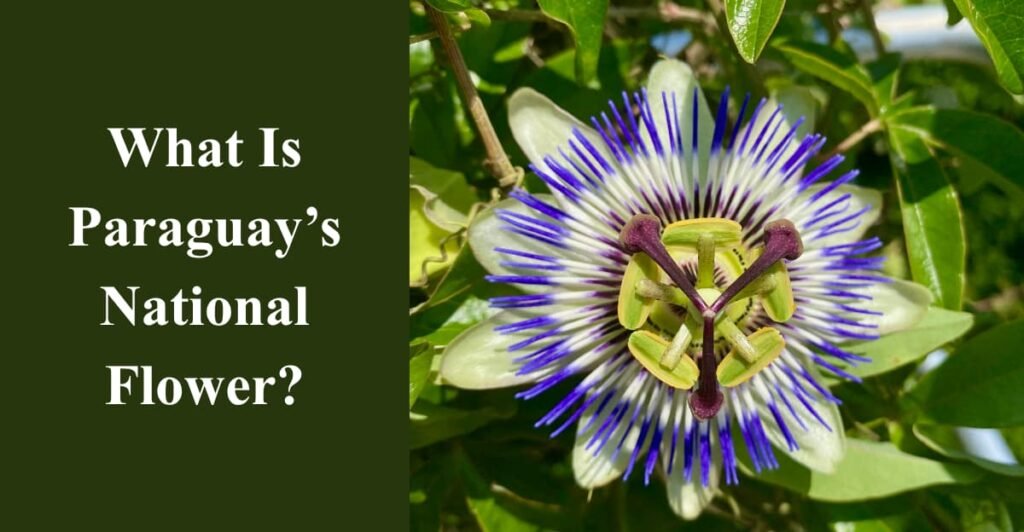
Paraguay’s national flower has a fascinating dual narrative, with the Mburucuyá (Passionflower) serving as a national floral emblem, while the Mbocayá flower, or blossom of the native coconut palm, holds strong official status through the country’s cultural and legal traditions. Together, these flowers represent the wild, sprawling natural beauty and deep-rooted cultural and religious traditions of Paraguay.
The climbing vine Mburucuyá has a complex, clock-like structure, while the thorny palm tree Mbocayá stands prominently across the Paraguayan landscape, reflecting subtropical biodiversity, resilience, and the nation’s historical connection with the Guaraní people, who valued these indigenous treasures for food, medicine, and spiritual practices.
In my experience studying Paraguayan flora, seeing these plants in Asunción and rural interiors makes their role as living symbols and natural decorations especially clear. Their connection with local traditions shows how botanical heritage can remain meaningful across centuries.
The Official National Flower of Paraguay
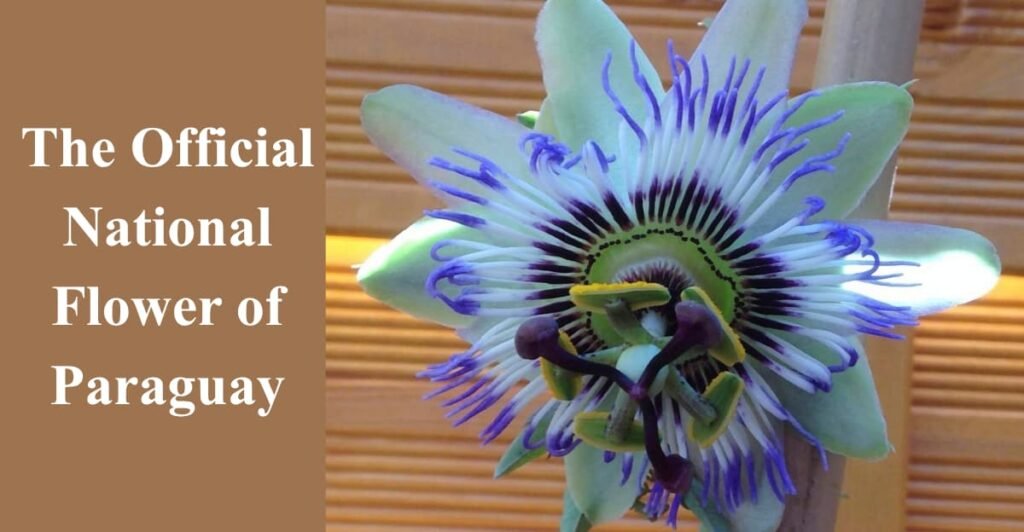
The formal recognition of Paraguay’s national flower reflects the country’s effort to unite its natural heritage under a meaningful national symbol. Legally, the Mburucuyá, scientifically known as Passiflora caerulea, represents the nation’s vibrant spirit and aesthetic grace, while the Mbocayá flower, from Acrocomia aculeata palm, holds national status through cultural decrees and its role as a National Plant.
This dual recognition is unusual in South America, where many nations select a single blossom, whereas Paraguay celebrates both a vine and a palm for their hardiness and importance to the local flora. These plants were officially sanctioned during periods of mid-20th-century nationalistic revival, strengthening Paraguayan identity among its neighbors, and their presence on currency, government documents, and educational materials serves citizens as a constant reminder of the nation’s botanical legacy.
In my experience researching Paraguay’s flora, the Mburucuyá and Mbocayá stand out for how naturally their botanical beauty connects with the country’s Paraguayan identity and botanical legacy.
Scientific Name and Classification of the Mbocayá Flower
From a scientific perspective, the Mbocayá flower belongs to the Arecaceae family, with the scientific name Acrocomia aculeata. This majestic palm has a trunk covered with dark, protective spines, while its flower develops from a spathe, a large woody sheath that opens into a dense, branched cluster of small, creamy-yellow blossoms.
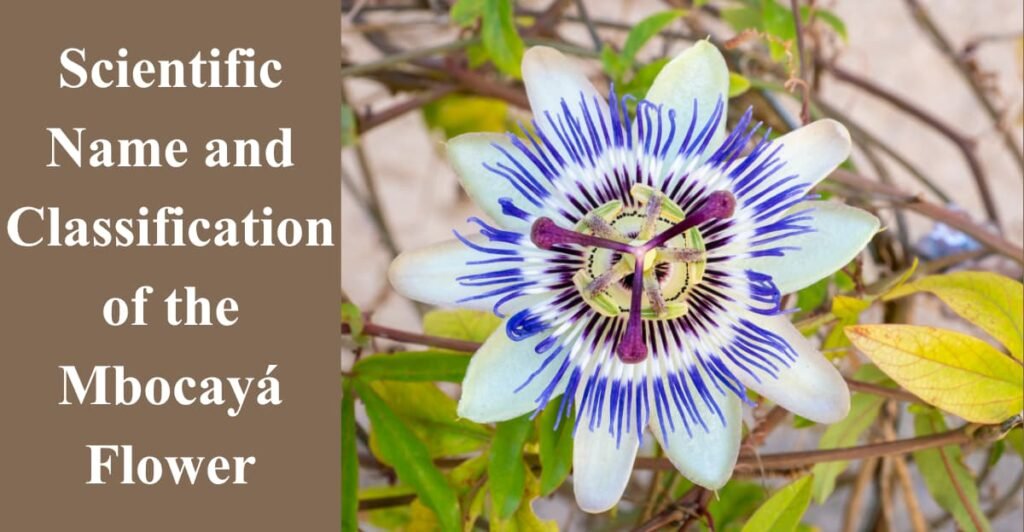
For comparison, the Mburucuyá belongs to the Passifloraceae family and is scientifically classified as Passiflora caerulea. Botanists describe it as a dicotyledonous perennial vine with intricate floral parts, including corona filaments, five anthers, and three stigmas, making it fascinating from the perspective of evolutionary biology. Both plants thrive in the humid subtropical climate of the region, adapting to different soil types across the Gran Chaco, the Oriental region, and Paraguay.
In my experience studying flower classification, comparing these two plants makes their contrasting structures and adaptations especially fascinating.
History Behind Paraguay Choosing Its National Flower
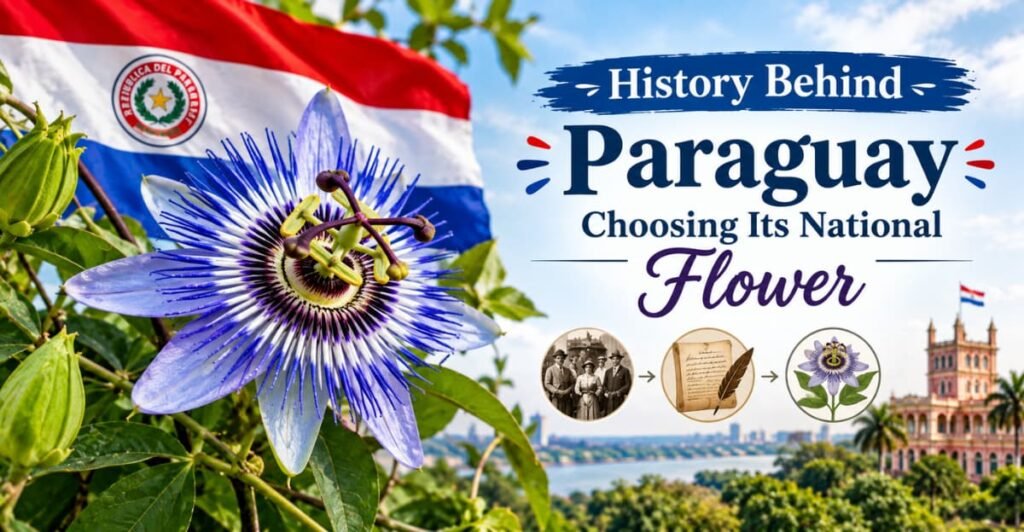
The history of selecting a national flower reflects Paraguay’s long search for identity, shaped by the Jesuit missions, indigenous Guaraní culture, and changing national traditions. The Mburucuyá was favored by early European settlers because its distinctive floral structure was associated with the instruments of the Passion of Christ, including the crown of thorns, nails, and wounds, helping connect the plant with the colonial religious narrative.
The Mbocayá palm, however, was chosen because of its utilitarian history and importance to the Guaraní. Its nuts provided oil, while its trunk offered shelter, helping communities survive floods and droughts. In the early 1900s, following regional conflicts, these plants were formally adopted as national symbols, creating a bridge between sacred traditions of the past and agricultural potential for the future. The decision went beyond aesthetic appeal, becoming an act of honoring the plants that had sustained the population for millennia.
In my experience researching Paraguayan botanical history, the connection between practical survival, sacred traditions, and national identity makes these plants especially meaningful.
Symbolism and Meaning of Paraguay’s National Flower
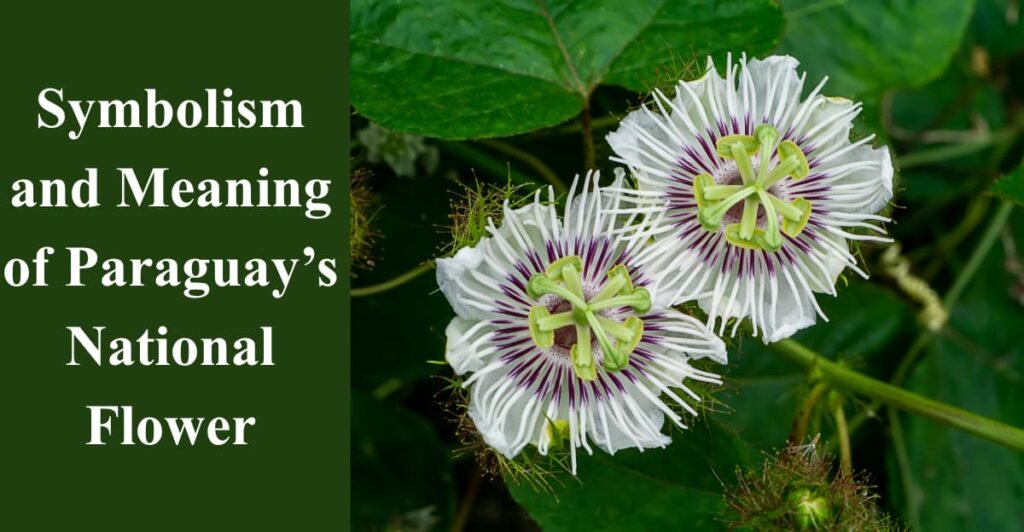
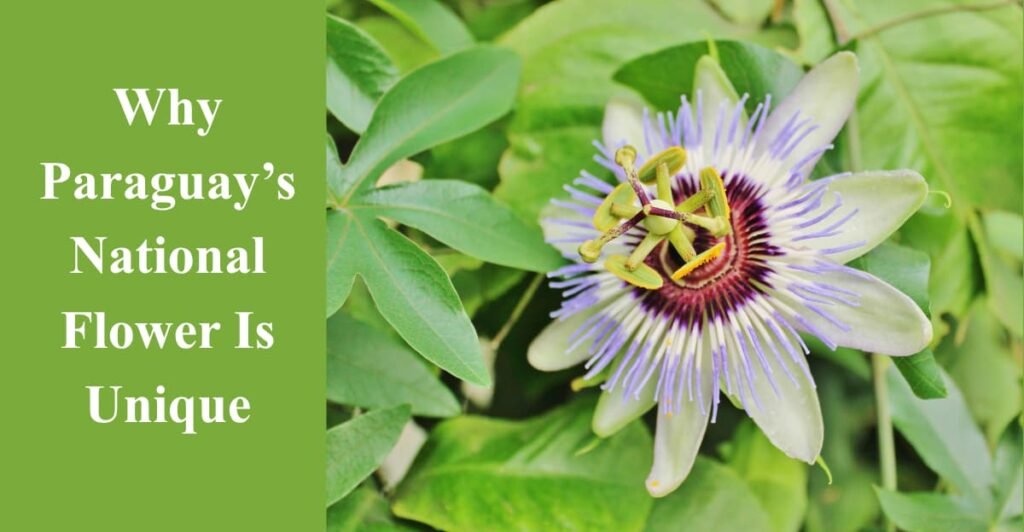
The symbolism and meaning of the Mburucuyá are multifaceted, representing purity and mysticism through its blue and white filaments. The corona evokes the sky and clouds, while its central structure suggests a steadfast heart, giving the flower associations with tranquility, calm, and the peaceful nature of the Paraguayan countryside, or campo. The Mbocayá, meanwhile, represents abundance and protection, as the palm provides oil, flour, and shade, making its flower a symbol of a blessed harvest.
Together, these flowers contribute strongly to national identity and sovereignty. As indigenous species with distinctive density and presence, they can be viewed as a natural flag of the republic, embodying the concept of Vencer o Morir, or Conquer or Die, the national motto. Their ability to grow and bloom across challenging terrains reflects resilience, endurance, and the enduring spirit of Paraguay.
In my experience studying floral symbolism, the contrast between the Mburucuyá’s spiritual imagery and the Mbocayá’s practical abundance makes their cultural meaning particularly powerful.
Cultural Importance of the Mbocayá Flower in Paraguay
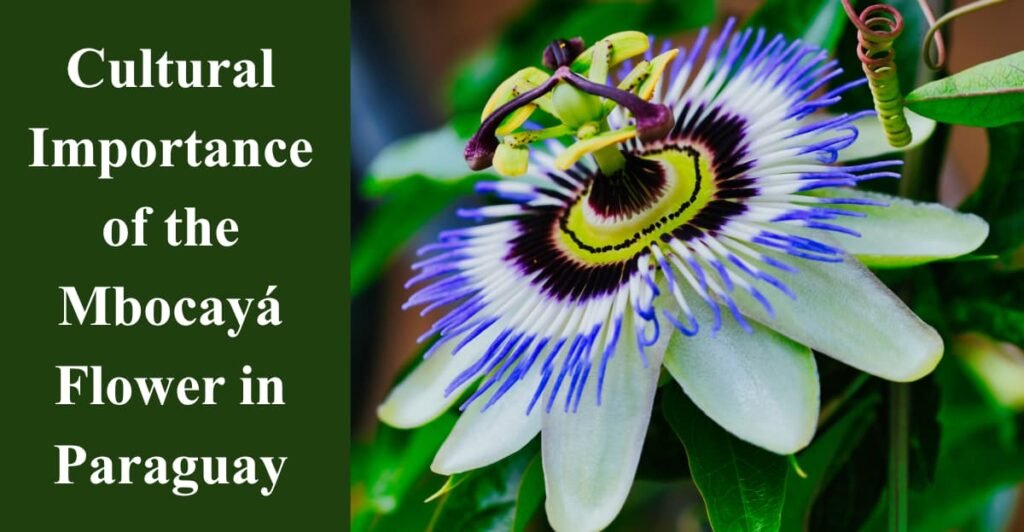
In Paraguay, culture is experienced beyond museums, especially through the fragrance carried in the air by the Mbocayá flower, whose quintessential scent is strongly associated with Paraguayan Christmas. During December and the summer season, Asunción and surrounding towns fill with the sweet aroma of palm blossoms, which are sold at street corners in large bundles as an essential component of the Pesebre, or nativity scene. These Christmas traditions see families placing flowers around the nativity to honor the birth of Jesus, while Guaraní Folklore presents the palm as a Tree of Life in indigenous myths.
The flower also provides artistic inspiration, with the intricate geometry of the Mburucuyá influencing the patterns of Ñandutí lace, a world-famous Paraguayan craft. In folk songs, polkas, and guaranis, which are traditional musical genres, these symbols frequently evoke love and the homeland. This deep cultural saturation ensures that the national flower remains a living entity rather than a static symbol limited to a coat of arms.
In my experience researching Paraguayan traditions, the connection between floral fragrance, celebrations, crafts, and music makes the Mbocayá feel like a living part of everyday culture.
Where the National Flower Grows in Paraguay
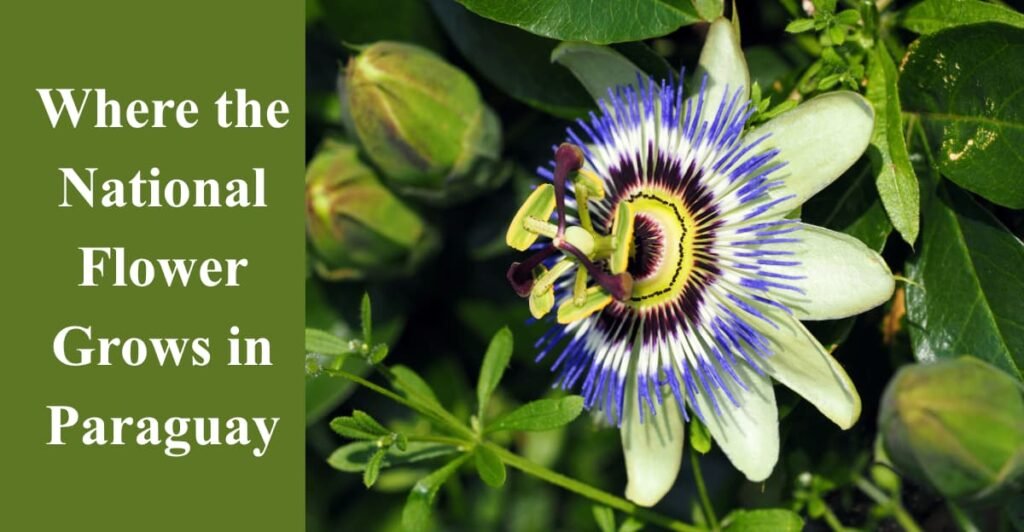
Paraguay’s unique geography provides a diverse range of habitats for its national symbols. The adaptable Mburucuyá vine can grow over fences in suburban gardens or climb high canopies within Atlantic Forest remnants in the east, where high humidity, sunlight, and the Paraguayan climate support abundant growth. The Mbocayá palm, meanwhile, is a dominant feature of the savannas and central plains, particularly across the departments of Cordillera, Paraguarí, and Central. As a pioneer species, it can help plants recolonize cleared areas and disturbed areas, demonstrating remarkable resilience even as urban areas expand, keeping the national flower visible to the general population.
From my experience studying plant habitats, seeing how these species adapt to gardens, forests, and open landscapes is one of the clearest signs of their ecological importance.
Physical Characteristics of Paraguay’s National Flower
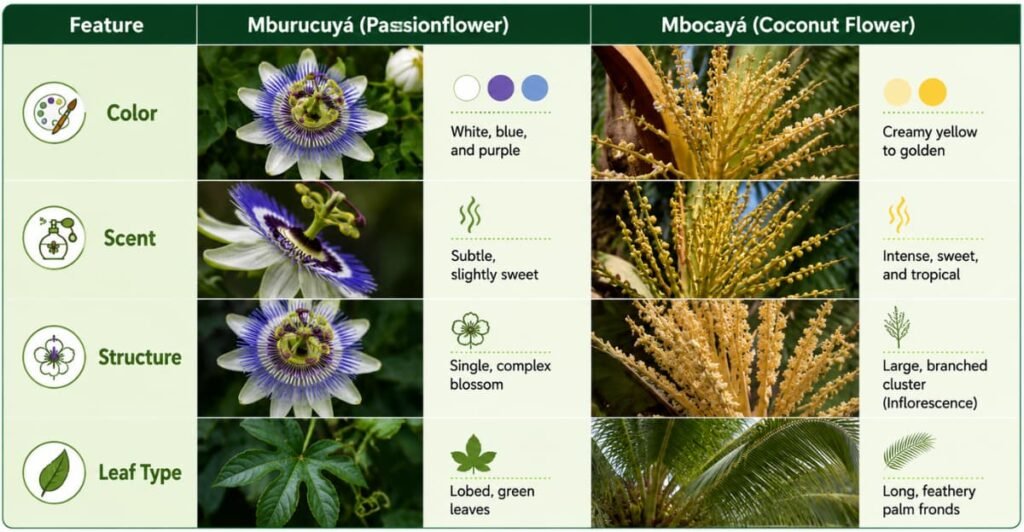
This pic shows the contrasting colors, floral structures, textures, and overall visual beauty of Paraguay’s Mburucuyá and Mbocayá flowers.
The physical appearance of these flowers reveals remarkable complexity and contrast. The Mburucuyá has radial symmetry, with blossoms about 3 to 4 inches wide, a circle of white petals, and a fringe of violet filaments designed to attract specific pollinators, especially the large carpenter bee, which interacts with its reproductive organs.
The Mbocayá, or Coconut Flower, contrasts with white, blue, purple, creamy yellow, and golden tones, ranging from a subtle, slightly sweet scent to an intense, tropical fragrance, with a single, complex blossom versus a large, branched cluster or inflorescence; its lobed, green leaves contrast with the long, feathery palm fronds, creating distinct visual experiences across the Paraguayan landscape, from an individual jewel of the vine to a golden fountain of the palm.
When the Mbocayá Flower Blooms
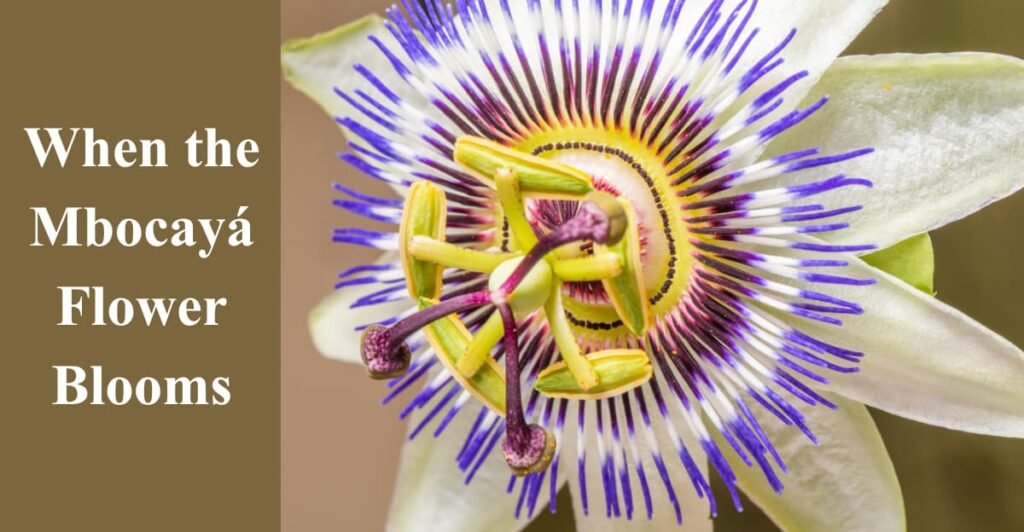
The timing of the Mbocayá life cycle centers on its flowering season, which begins in late spring and reaches its peak in December, during the Southern Hemisphere summer heat. The spathe opening is a dramatic event in the natural world, releasing a burst of fragrance detectable from several meters away.
The Mburucuyá has a longer blooming period, continuing flowering through the autumn months as a prolific bloomer that produces new flowers daily while its vine expands. This long-lasting presence makes it a reliable symbol throughout the year, while gardeners value it for bringing constant color and life to the landscape, unlike national flowers that may bloom for only a few brief weeks.
In my experience observing flowering cycles, the contrast between Mbocayá’s seasonal peak and Mburucuyá’s extended bloom makes both especially valuable to gardeners and the landscape.
Traditional Uses of Paraguay’s National Flower
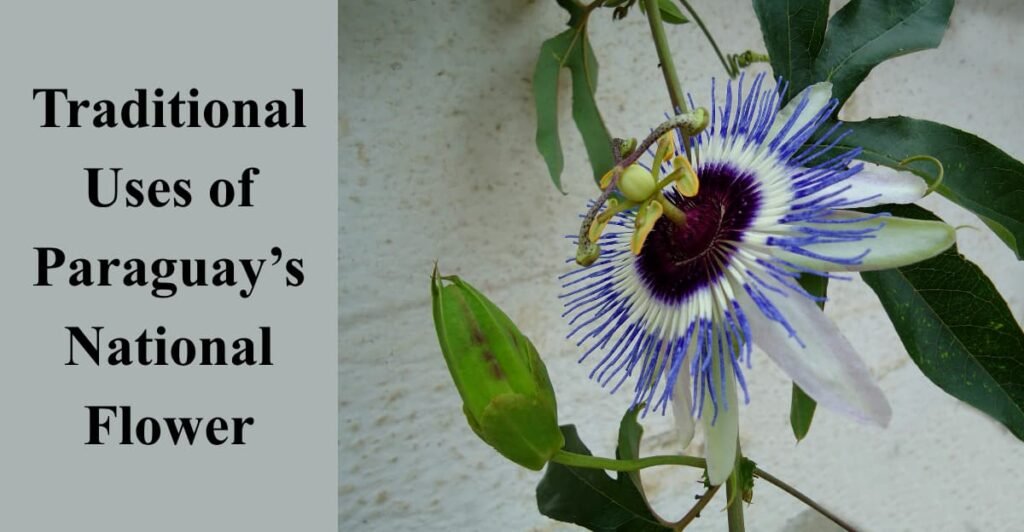
The utility of these plants is a cornerstone of Paraguayan ethnobotany, with Mburucuyá remaining a staple in the remedio yuyos herb market. Its leaves and flowers are dried for infusions traditionally associated with nervous disorders, while it is also a common addition to Tereré, the national drink of Paraguay, where it is added to water for a calming effect during hot afternoons.
The Mbocayá flower is valued for its aromatic properties in religious settings, while the wider plant is a super-resource: the pulp of its palm fruit can be made into traditional flour, and its kernel produces high-quality oil used in cooking and Paraguayan soap. This long-standing tradition of usage keeps the national flower an active part of the country’s economy and health practices, reinforcing its importance and symbolism beyond appearance alone.
In my experience researching Paraguayan plant traditions, the combination of everyday utility, cultural practices, and symbolic importance makes these flowers particularly fascinating.
Role of the National Flower in Paraguayan Traditions and Festivals
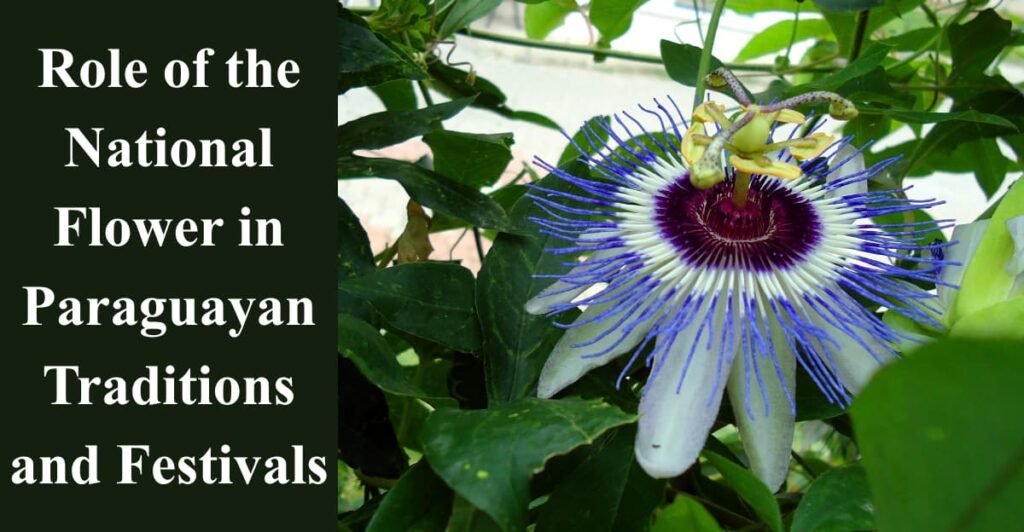
The national flower plays an important role in Paraguayan traditions and festivals, extending from Christmas to civic festivals. During Independence Day celebrations on May 14-15, Mburucuyá appears in floral arrangements decorating public stages and parades, symbolizing the fertility of the Paraguayan land, along with hope for a prosperous future.
In rural communities, the blooming of the Mbocayá signals the beginning of the harvest season for many crops and is celebrated through festivales del coco, or coconut festivals, where palm products are showcased. Traditional dances, including the Danza de la Botella, feature dancers balancing bottles on their heads, sometimes decorated with vines of the Mburucuyá, bringing music, dance, and religion together as a vibrant cultural fabric of the Paraguayan experience.
In my experience researching Paraguayan celebrations, the way flowers connect festivals, harvests, music, and religious traditions makes their cultural role especially memorable.
Paraguay’s National Flower vs Other South American National Flowers
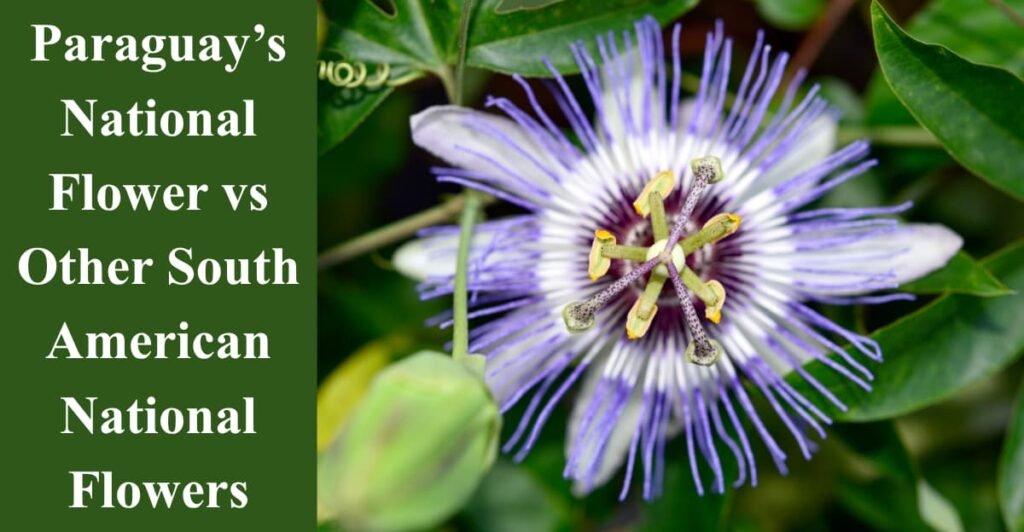
Paraguay’s national flower stands apart from its South America neighbors, particularly Argentina and Uruguay, whose Ceibo (Erythrina crista-galli) is a bright red tree flower with a striking appearance, while Paraguay’s Mburucuyá and Mbocayá carry a more complex medicinal narrative and religious narrative. Brazil’s Ipê-amarelo, a yellow flowering tree, is also admired mainly for its ornamental beauty, whereas Paraguay’s national symbols are distinguished by their unique, multipurpose nature in the botanical world.
Both Paraguayan flowers are functional, edible, and medicinal, reflecting the pragmatic nature and resourceful nature of the Paraguayan people, who have historically depended on the land’s natural bounty during challenging times. The Mburucuyá’s climbing habit and the Mbocayá’s thorny trunk further symbolize a nation that is adaptable while remaining protective of its borders.
In my experience comparing South American national flowers, Paraguay’s combination of beauty, practical value, and cultural meaning makes its floral identity especially distinctive.
Interesting Facts About Paraguay’s National Flower
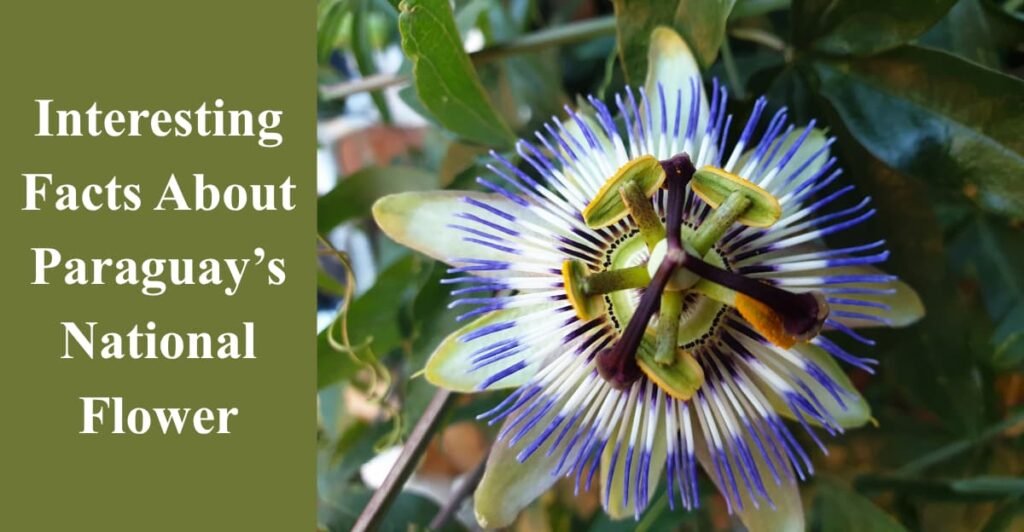
Several lesser-known aspects add to the allure of these plants. The Mburucuyá produces a fruit classified as a berry, containing hundreds of seeds, with each seed surrounded by a juicy aril. In the wild, the flower demonstrates remarkable mechanical movement, as its stigmas can shift into contact with the back of a visiting bee, an intriguing example of plant intelligence.
Another interesting fact concerns the Mbocayá, whose potent fragrance has been studied by perfumers seeking to capture the scent of the tropics. During the Triple Alliance War, the palm reportedly served as a lifesaver for soldiers and civilians, who relied on palm hearts and nuts when other food supplies were exhausted.
In my experience researching these plants, their unusual pollination mechanisms, powerful fragrance, and historical usefulness make their stories particularly fascinating.
How Paraguay’s National Flower Represents National Identity
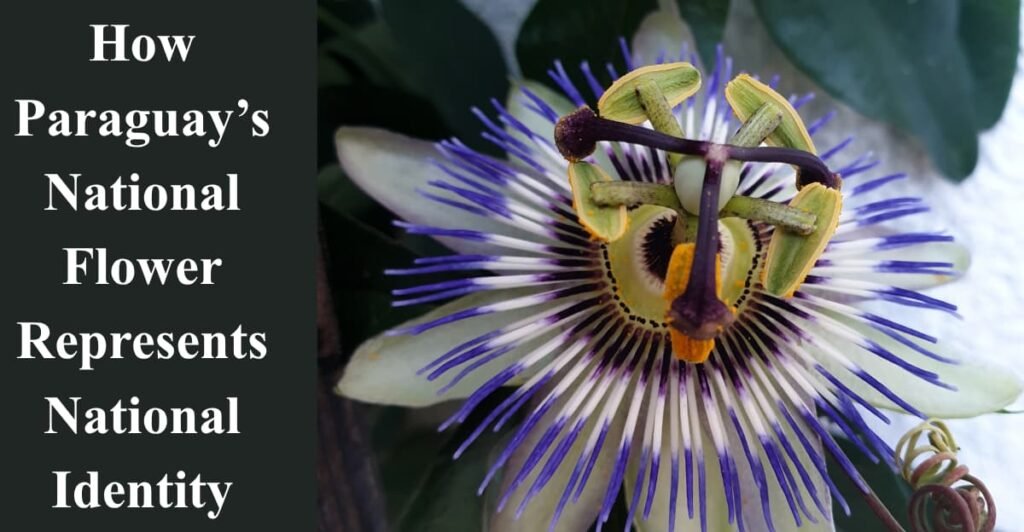
National identity often grows through shared symbols that create an emotional response. For a Paraguayan living abroad, seeing a Passionflower or Coconut flower can evoke techaga’u, a Guaraní expression for profound longing or homesickness, turning these flowers into a sensory reminder of the homeland in ways that a flag or song may not. The Mburucuyá reflects Paraguay’s intellectual side and spiritual side through its complex geometry and medicinal uses, while the Mbocayá represents the physical side and historical side through food and fragrance. Together, they create a balanced identity that is thoughtful, strong, traditional, and resilient, keeping these symbols central to the national conversation in Paraguay as the country enters 2026 and engages with a modern, globalized world.
In my experience studying national flowers, few symbols connect memory, heritage, and everyday life as naturally as Paraguay’s Mburucuyá and Mbocayá.
Conservation Status and Protection of the Mbocayá Flower
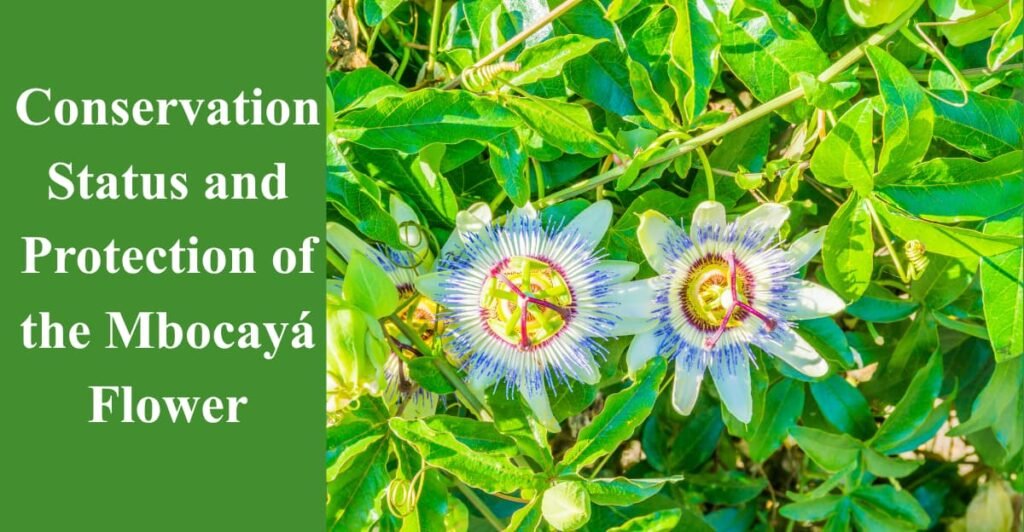
The Mburucuyá and Mbocayá are currently widespread, but climate change and deforestation remain important concerns. In 2026, Paraguayan environmental agencies are strengthening protection of the natural corridors where these plants thrive, while the main threat to the Mbocayá is the conversion of traditional palm groves into large-scale monoculture plantations. Because of the flower’s cultural status, strong public support encourages conservation through Urban Forestry initiatives in Luque and San Lorenzo, including the planting of Mbocayá palms in public parks.
Existing laws also regulate cutting palms, requiring government permits in protected circumstances. Protecting Paraguay’s national flower is therefore more than an environmental task; it is a duty to preserve the nation’s cultural DNA while maintaining habitats where these plants can continue to flourish.
In my experience researching plant conservation, protecting culturally important species becomes more effective when environmental action is connected with public pride and local traditions.
Why Paraguay’s National Flower Is Unique
The uniqueness of Paraguay’s national flower comes from its inseparability from the people and everyday life. Unlike national symbols found only in remote mountain ranges or botanical gardens, the Mburucuyá and Mbocayá are part of the everyday landscape, growing in the yards of the rich and poor alike and helping bridge social gaps through a shared appreciation of their beauty and scent.
Their combination of religious history, indigenous myth, medicinal value, and economic utility makes them remarkably hard-working national symbols and a testament to how meaningful symbols can serve both the body and soul. As the Mburucuyá climbs and the Mbocayá blooms through the December heat, their presence keeps the spirit of Paraguay vibrant and alive.
In my experience studying culturally important flowers, their presence in ordinary homes and landscapes makes their national significance feel especially authentic and deeply connected to everyday Paraguayan life.
Conclusion
Paraguay’s national flowers, the Mbocayá and Mburucuyá, beautifully reflect the nation’s natural heritage, cultural identity, history, and traditions. From their symbolism and traditional uses to their role in festivals and biodiversity, these flowers remain deeply connected to Paraguayan life. Explore their remarkable beauty, meaning, and cultural importance to better understand why they continue to represent the vibrant spirit of Paraguay.
Frequently Asked Questions
1. What is Paraguay’s national flower?
Paraguay’s floral identity is associated with the Mburucuyá (Passionflower) and the Mbocayá flower, each carrying important cultural and historical significance.
2. What is the scientific name of the Mbocayá flower?
The Mbocayá comes from the palm Acrocomia aculeata, a species belonging to the Arecaceae family.
3. What does the Mbocayá flower symbolize?
The Mbocayá symbolizes abundance, protection, resilience, cultural heritage, and national identity in Paraguay.
4. What does the Mburucuyá flower symbolize?
The Mburucuyá is associated with purity, mysticism, tranquility, spirituality, and Paraguayan cultural traditions.
Please Write Your Comments